Friday, February 10, 2017

Update of cruise schedule and sea ice report

Alberto sent an email on 07Feb indicating that the cruise is very likely to depart Punta Arenas on 17 March, and return to Montevideo on 8 May. We are nearly ready to start booking flights.

Another report from Alberto concerns the sea ice extent. As this trip aims to do open ocean measurements, the absence of sea ice is a plus. Turns out that the ice extent is somewhat low relative to last year, with no ice presently in the Orkney Passage. The following images are courtesy of Povl Abrahamsen of BAS (another scientist on the cruise). 
 
Map of Southern Ocean sea ice concentration on 08 Feb, 2017, showing high concentrations to the east of the Antarctic Peninsula, but not much in the Orkney Passage (northeast of the Peninsula). 
 
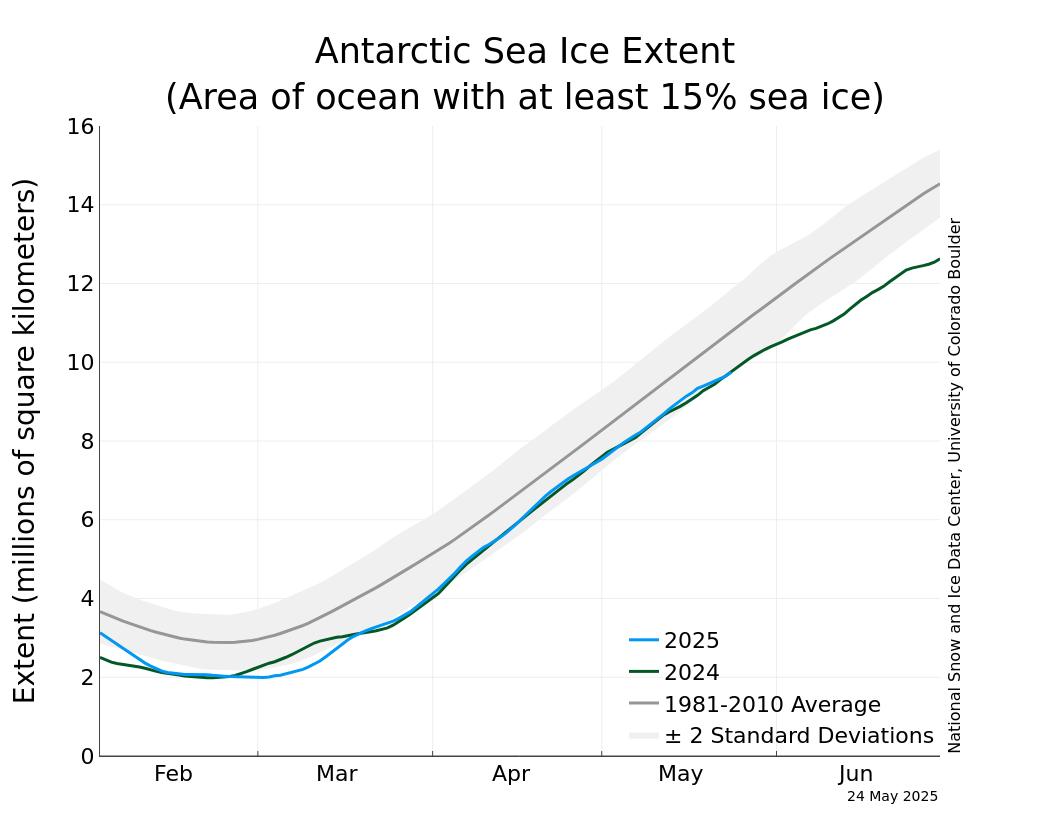
Time series for Southern Ocean sea ice extent, showing less sea ice than last year. Note how the sea ice extent starts to increase as the Southern Hemisphere enters its autumn season in March. Since we will be in the water March-May, we will need to work hard to avoid sea ice, with the cruise track designed with that goal in mind.

Saturday, January 28, 2017

Some information about the RRS JC Ross

The JC Ross web page has a good bit of information about the ship and its location.  I have found it useful to see a bit of the space where work, lounging, eating, sleeping, etc. will take place for eight weeks of my life.

Virtual Tour of the JC Ross
Itinerary of JC Ross
Ship Tracker
Web camera (photo every 15minutes)

Thursday, January 26, 2017

When is the cruise?

That is a question I keep pondering, as do my family and work colleagues. The dates, unfortunately, are less than solid.  No one knows for sure.  

Alberto today told me why the dates are uncertain.  Namely, the JC Ross is a vessel for scientific investigations, such as the DynOPO cruise. Also, it is a vessel for logistical support.  Well, it turns out that a major logistical support issue arose this season due to a massive crack opening in the ice sheet a few kilometres from the Halley VI Research Station, located on the Brunt ice shelf in the Weddell Sea.  Halley was planning to move already.  But this crack has made that move more urgent, as indicated by this news article from 16Jan2017. If you go to the link for Halley VI, you will see that this research station is spectacular, with heaps of gear and living pods. Correspondingly, the move requires significant logistical support, with the JC Ross playing a role. 

Given the priority for the JC Ross to support the Halley move, and the uncertainty in completion of the move, Alberto suggests that we will not know for sure of dates for our cruise until around two weeks prior to its departure date.  Thus is life as a seagoing oceanographer: adventure of an uncertain kind and uncertain time!   Nonetheless, there are tentative dates, which are as follows: departure from Punta Arenas, Chile on 17March and disembark in Montevideo, Uruguay on 08May. 

One added note: this crack in the Brunt ice shelf is distinct from another crack that is creating lots of attention. Namely, the Larsen C shelf on the Antarctic Peninsula has a growing crack.  Larsen C is the sibling of Larsen B, with Larsen B having disintegrated in 2002. 

Wednesday, January 25, 2017

How to prepare for the cruise?

I find myself wondering how to prepare for an eight-week research cruise in the Southern Ocean. One focus I have concerns the need to prepare others for my absence.  Being away from home will be tough, particularly given the sporadic communication available on the ship.  This trip is very different than a few days in Asia, Europe, or Australia.  In fact, I have yet to tell some of my family about this cruise, largely since it was not until 23Jan that I was given medical permission to go.  Once the technical details are settled for how others can access this blog (I am still a bit unsure about subscribing, etc.) I will be spreading the word. 

For work, I am trying to settle some of my many tasks and to reach a hand-off point with certain ongoing projects. Alas, such aspirations remain a never-ending quest for the impossible.  There is always a new idea to develop, or a new analysis to pursue. Such is the nature of research. The bottom line is that elements of my regular work life will simply need to be placed on lower priority while I am away.   And I am sure others will fare well in my absence. 

Physically, I am trying to stay healthy and fit.  Life on the ship may offer some form of exercise situation, as I understand they have a small gym, and many folks often organize into a regular exercise period (yoga perhaps?).  But my presumption is there will be far fewer options than a normal day in Princeton. Mentally I am trying to read material relevant to the research to be conducted.  I am also trying to relax into the notion of being less than comfortable for eight weeks away from home. Spiritually, the notion of being on the sea away from land for an extended period is both exhilarating and confronting. Hopefully I will be able to bring some meditation practice on board the ship, as well as some yoga. Doing so will help me to relax into the absence of control.  Tossed around on a ship in the Southern Ocean for eight weeks is perhaps the nearest one can get to being totally under the will of natural forces; that is, short of walking across Antarctica!       

Monday, January 23, 2017

Medical permission granted

Just today, 23 Jan 2017, I was informed that the British Antarctic Survey (BAS) doctors have approved my medical forms. That is, the BAS doctors say that I can go on the cruise.  This news is a big relief.  As some of you know, in June-July 2015 I experienced a few weeks with atrial fibrillations (A-fib). I had a cardiac ablation procedure to stop the A-fibs on 09 July 2015.  Thankfully, the ablation was successful, with no A-fibs since.  Furthermore, all other other heart features are healthy.

Nonetheless, I was concerned that by having a history of heart issues, the cruise doctors would deny me access to the cruise. The BAS doctors certainly have need to ensure that cruise participants are fit. Ships at sea, especially in the Southern Ocean, are not readily accessible for emergency situations. So it was with some satisfaction that my Princeton doctors, as well as the BAS doctors, gave me a good bill of health.

Thursday, November 17, 2016

Nature article on Southern Ocean science

This article in Nature offers a great summary of key research ongoing in the Southern Ocean.  The article has quotes from various collaborators from Princeton, Australia, and the UK. When I am through with Princeton University teaching later this autumn, I hope to summarize elements of the article within this blog.  In the meantime, if you have 10-20 minutes to read it, you will garner a nice summary of certain big-picture scientific reasons for pursuing this research.  

Monday, October 24, 2016

Boaty MacBoatface


What is Boaty MacBoatface?

The UK is presently building a £200 million state-of-the-science ocean research ship, with planned completion sometime in 2019. The UK public was invited to vote on a name for the new ship. The overwhelming winner was the tongue-in-cheek name Boaty MacBoatface. This name left those higher-ups in the UK a bit unsure of whether to let democracy rule, or to use a more respectable name.  After a period of navel pondering, the new vessel was named the RRS Sir David Attenborough, in honour of the filmmaker and naturalist who has contributed so much to our view of the planet and the joys of earth science.

However, in an acknowledgement of the democratically elected name, the UK has decided to use Boaty MacBoatface as the name for new autonomous vehicles to be used in future UK oceanographic research missions. As described by this link, Boaty MacBoatface will be inaugurated on the 2017 DynOPO cruise in the Southern Ocean. According to my UK colleagues, Boaty is an amazing tool for observational oceanography.